Count Öderland
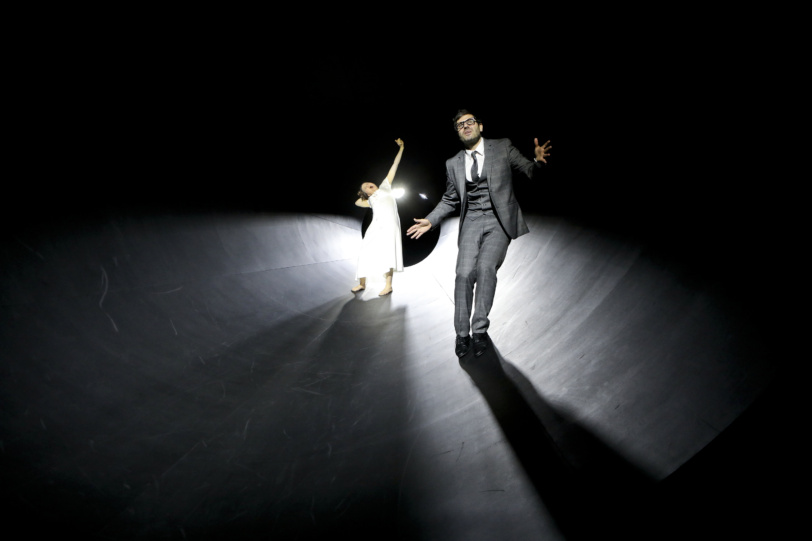
A huge trumpet-shaped stage faces the audience, where on a gigantic slope people confuse dreams with reality, disrupting the continuous flow of time and reflecting on class contradictions.
Count Öderland (Graf Öderland) tells the story of a bank clerk who kills a guard with an axe, which seems to be a senseless murder. Only the prosecutor shows sympathy for the crime and is inspired by it to break through conventional life. From then on, he follows the legend of Count Öderland, wandering the countryside with an axe, killing all those who oppose his claims of freedom. Under Count Öderland’s leadership, followers unite, and the prosecutor’s personal actions develop into a widespread uprising. In the end, the rebellion causes political turmoil, but the freedom the prosecutor desires is never realized.
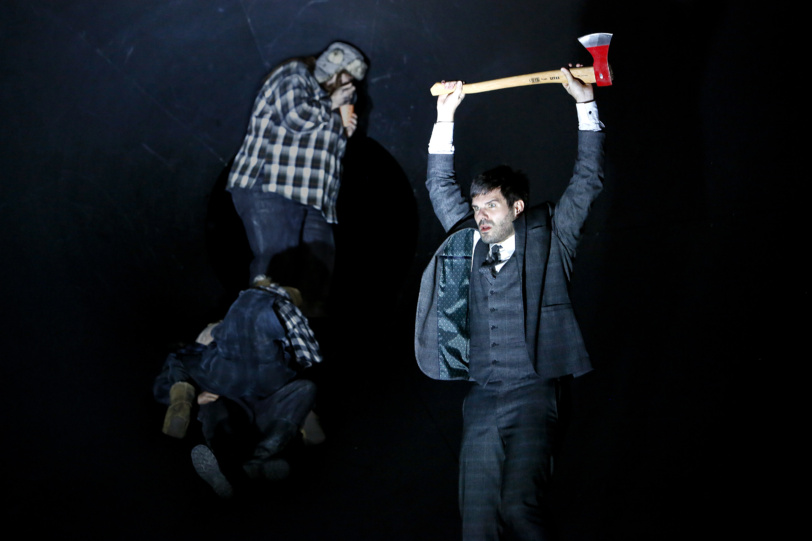
The original work consists of 12 chapters. Each chapter moves forward on the timeline, but they are not entirely coherent, using a montage-style transition. In Bachmann’s stage adaptation, the montage is preserved, but the chronological order is adjusted. Without affecting the narrative, flashbacks are interspersed from time to time. The entire 12-chapter structure is like twelve fingers intertwined, blending very well.
One of the most important themes of this play is dreams and reality. The prosecutor enters a dream state from the moment he kills the first person in the forest cabin, but upon waking at the end, he finds everything that happened in the dream was actually real. Whether as a reader or audience member, encountering this interplay between dreams and reality induces the same confusion as the protagonist. The most brilliant part of the entire play is that it does not treat dreams and reality as opposites, but rather lets fantasy become reality and reality remain fantasy. This, in fact, is the essence of drama. Watching normally, one feels the director perfectly fulfills the original author Max Frisch’s description of the stage: “Terrifying, but unreal.”
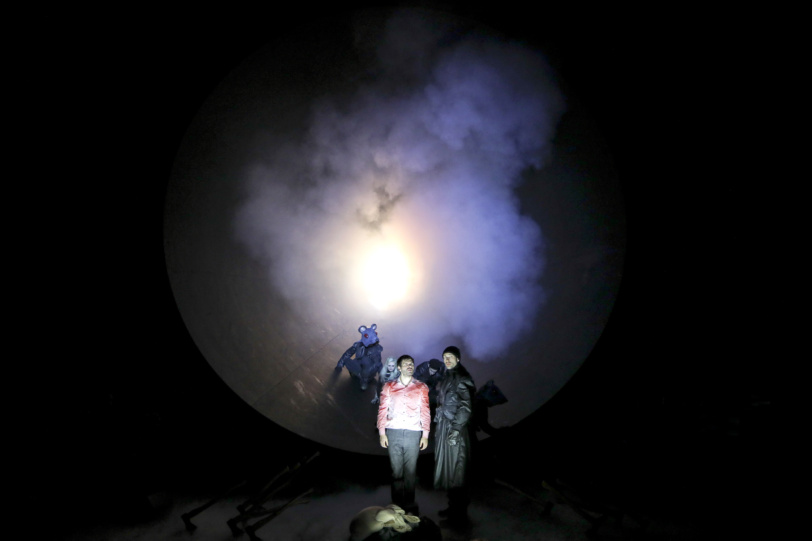
Director Stefan Bachmann comes from an opera directing background, and this version of Count Öderland bears many operatic influences. Before the performance starts, the first to appear is a small ensemble composed of piano, violin, clarinet, and bass, who provide sound effects throughout the performance. Singing segments are also inserted during the show. The most exciting moment is when the rebels of Öderland hammer their axes into the stage floor, and the live band begins performing rock music in the style of Rammstein. Various forms of music on stage are not unfamiliar to those accustomed to German theater, but Bachmann’s use of music is more skilled and effortless than most. Now serving as the director of the Cologne Theater, Bachmann is a director worth paying close attention to in the future.
Of course, the stage design by Olaf Altmann is also the centerpiece of the entire performance. The trumpet-shaped giant stage with a steeply sloped floor on one hand reflects the distortions of objects in dreams, and on the other hand causes characters standing in different positions to appear distorted in size due to perspective.
Max Frisch wrote three versions of this work in total, none of which were well-liked. The second version was even forced to be revised because it was believed to be an allegory of the Nazis’ rise to power. Finally, over seventy years later, under the director’s brilliant touch, this work was listed among the top ten at the 2021 Berlin Theater Festival.
9/10