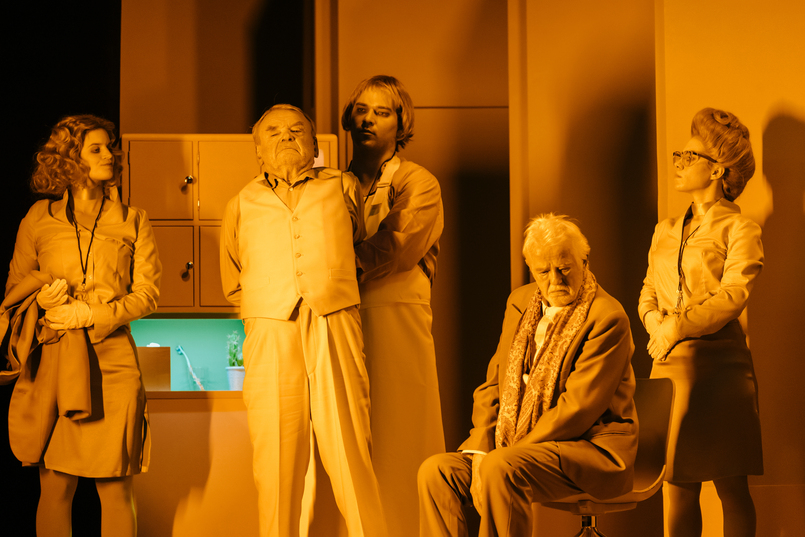
Zwiegespräch (Dialogue)
With half the seats in the audience empty, ridiculously small legroom, coming to see a play in Austria for the first time clearly felt a different atmosphere compared to Germany. Peter Handke’s new book Dialogue was also brought to the stage of Vienna’s Burgtheater by a new-generation director Rieke Süßkow just two days after Handke celebrated his 80th birthday.
Without fixed roles or instructions for the actors, Handke’s new book is less of a script and more like a dramatically charged prose poem. What moves readers is not the content of the text, but the atmosphere and sadness hidden between the lines. In Handke’s previous work Zdeněk Adamec, the protagonist is a young person disillusioned with the world who chooses to self-immolate in a square in Prague at the point of utter despair. This section of Dialogue tells of the opposite extreme: an elderly person facing the end of life, full of reluctance and helplessness about the imminent end of the journey.
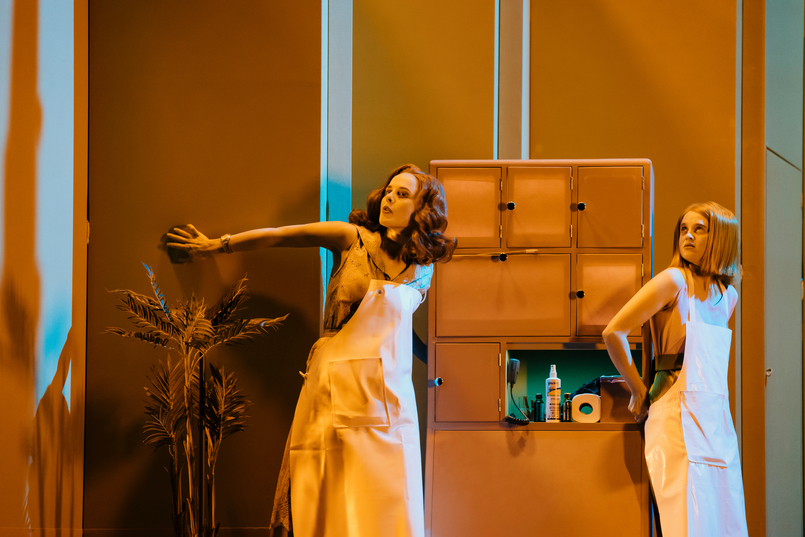
In Süßkow’s version, the stage is split in two. On one side, an elderly person in a nursing home recounts their youth; on the other, young nurses perform casual care for the elderly. Whenever the nurses sing “La Paloma,” the elderly play a game of musical chairs, and the loser must hand over all personal belongings and is forced off the stage. Staging such a scene on this stage inevitably recalls the “nurse murders” incident that happened in Vienna in the 1980s—bizarre music, twisted body movements, and suddenly halted rhythms completely replicate the style of season two of American Horror Story.
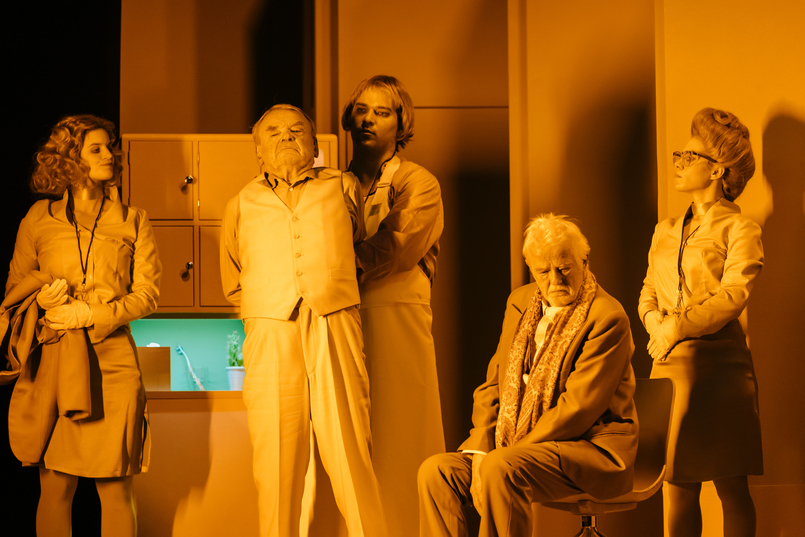
When facing Handke’s type of text—where “mood outweighs content”—it is crucial for the dramaturge to thoroughly digest and break down the text, then recreate it with their own unique poetry and flair. But every dramaturge approaches Handke’s works with a measure of reverence and cautiousness. This play is no different; the director has done their best to separate the original text and their own unique stage presentation, also weaving in their new-generation understanding of death. However, much of Handke’s powerful text remains preserved, leaving the audience with a discomforting sense of division, as if watching two completely different shows on two TVs simultaneously.
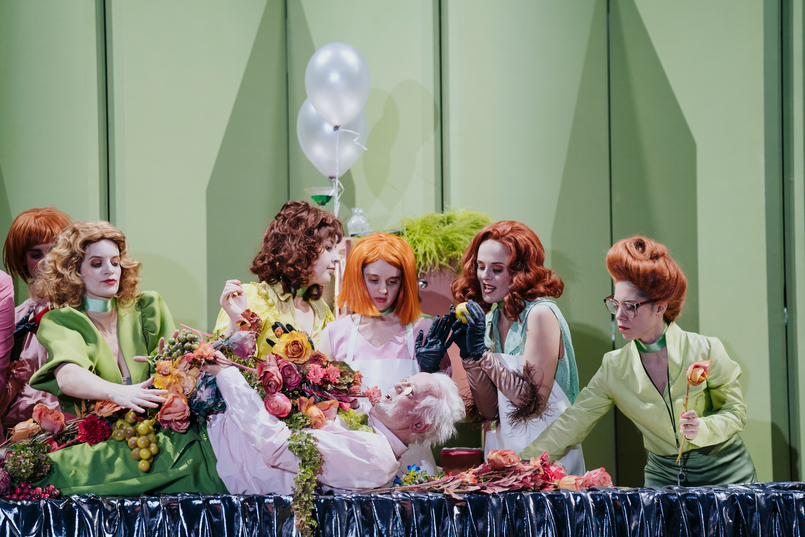
If we separate the two incompatible parts, firstly the text: Handke’s prose poem-like language, though barely conveyable through the excellent performances of the actors, remains too difficult for foreign audiences. Even the three experienced actors were repeatedly prompted on their lines on stage. One can imagine that even translating this text into English would be a heavy burden for non-native speakers. On the other hand, the director’s command of the stage elements is refreshingly impressive. Even if it seems she doesn’t fully grasp Handke’s work, her interpretation of “transmitting German drama” is skillful to the point of ease. The highly saturated contrasting stage lighting, the sudden start of techno music, the actors collectively going mad—all show that the director has given her utmost effort. As a multiple award-winning company in Austria’s top tier Burgtheater, the actors’ skills are equally astonishing. Whether it’s the seasoned xxx or the young actors around thirty, their acting could serve as headliners in theaters I often visit. For readers in Germany who don’t mind the trip to Vienna, this theater likely holds many surprises.
Selected among the top ten at the 2023 Berlin Theater Festival, it perhaps didn’t reach the top 10 level across the German-speaking region for me, but for audiences going to Berlin in May, especially those who rarely encounter German theater, I still highly recommend experiencing this play to feel what the author loves about the “indispensable elements of German theater” lol.
7/10
German difficulty: 5
Zwiegespräch
by Peter Handke
Directed by: Rieke Süßkow, Stage Design: Mirjam Stängl, Costumes: Marlen Duken, Music: Max Windisch-Spoerk, Lighting: Marcus Loran, Choreography: Daniela Mühlbauer, Dramaturgy: Sandra Küpper.
Cast: Hans Dieter Knebel, Elisa Plüss, Maresi Riegner, Branko Samarovski, Martin Schwab. Also Sara Abci, Nikolas Altmann, Katharina Franzel, Kolja Gerstmann, Hannah Lou Harrison, Katharina Hochreiter, Karla Howorka, Marko Jovanovic, Willfried Kovárnik, Edmund Lobinger, Hannah Pichler, Maximilian Schwertführer, Sara Siedlecka, Felix Von Gässler, Julia Carina Wachsmann, Brigitte Weinberger and Adam Hadj Mabrouk, Thomas Kern, Levi Powell.
World premiere on December 8, 2022
Duration: 1 hour 50 minutes, no intermission