Das Vermächtnis
A seven-hour theater marathon that keeps the audience inside the theater is not a medley of ancient Greek epics (“Dionysus Stadt”) nor a tome of Dostoevsky (“Anna Karenina oder Arme Leute”), but a story about the daily life of the gay community in New York.
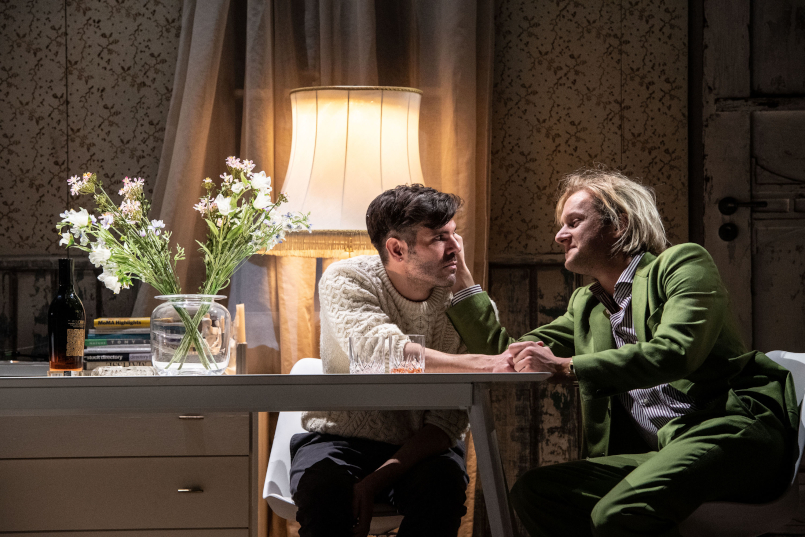
In Matthew Lopez’s play “Das Vermächtnis” (“The Inheritance”), the protagonist Eric is a human rights lawyer living with his boyfriend Toby—a narcissistic writer—in a high-end apartment in the Upper West Side of New York. Their relationship undergoes dramatic changes after they encounter a man named Adam in a bookstore… Eric welcomes Adam into their circle, and as Adam stars as the male lead in Toby’s play and falls in love with Toby, other characters outside the trio begin to emerge on stage. Lopez has created more than a dozen characters in the script. While the relationship among the three moves forward, the stories of sex worker Leo, real estate magnate Henry, and the kindly Walter gradually unfold alongside the protagonists’ narratives.
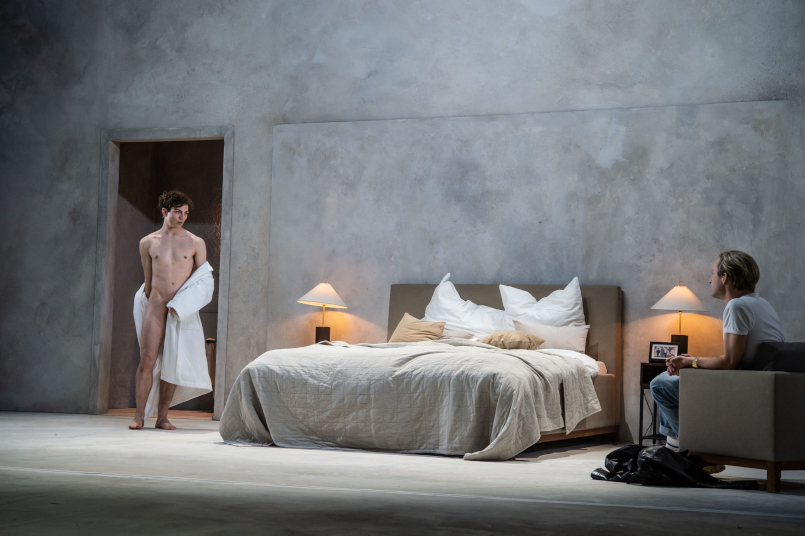
“The Inheritance” refers both to the hundreds-of-years-old house in the story that specializes in sheltering terminally ill gay men, and also to the legacy left by three generations of the New York gay community—ranging from the Stonewall riots, to the devastation of HIV, to widespread acceptance of LGBT communities during the Obama era. When minority groups face the achievements of today, they should not forget the countless blood and tears left by previous generations. It’s difficult not to compare this play to “Angels in America”. Compared to that, this “Inheritance” replaces the individual with the development of a community to portray the dilemmas of an entire era. The storyline and characters in the play are simple and easy to understand but richer than “Angels in America”. The tangled romantic stories between the characters are merely love stories, not “gay love stories.”
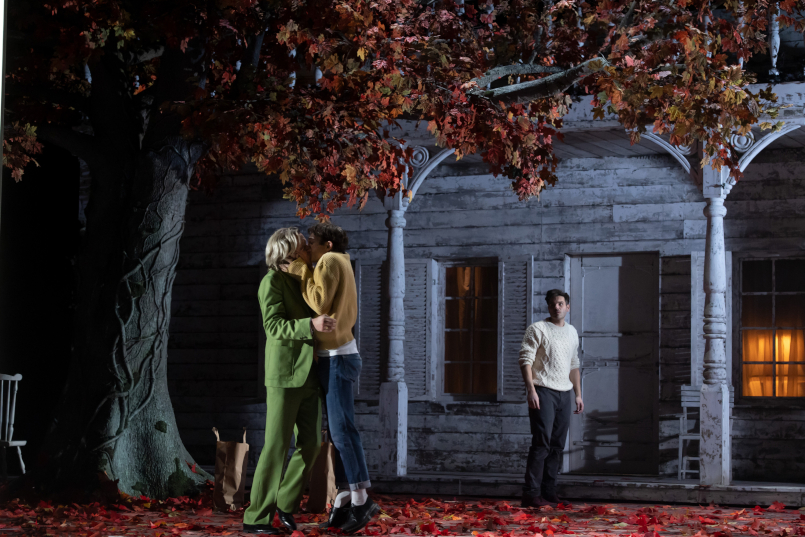
“The Inheritance” premiered in London’s West End to great success, then moved to Broadway. The version now staged for the first time in Germany is directed by Philipp Stölzl, who, as a film director, brings a cinematic feel to the production. Scene transitions, rise and fall of curtains, and interplay of foreground and background all reveal a rigorous Hollywood industrial vibe. New York, as the story’s setting, is vividly brought to life by the director, from the opening black brick wall, Strand bookstore shopping bags, Peter Luger steaks, to even a trash can on stage that looks exactly like one on the streets of Manhattan. Each of these details transports the audience instantly through time and space into the noisy, hedonistic world of New York—perfectly capturing the essence of “Sex and the City.”
Compared with other long plays lasting seven or eight hours, this part, aimed at bridging the two halves, feels more like a long TV series. After the first part unfolds all backgrounds and mysteries, the following story feels like a meaningless extension. Even though the quality of the work doesn’t decline, staying for the entire second part feels more like habit than expectation. What is most praised about this production is the acting. Familiar faces from the Residenztheater can easily create preconceived impressions for the audience, but the selfish arrogance and self-doubt of the cynical writer Toby (played by Moritz von Treuenfels) is portrayed in great detail. Vincent zur Linden’s first formal stage performance at the Residenztheater vividly brings to life the roles of Adam and Leo—from Adam’s initial timidity about New York to his later overconfidence after success; from a sex worker unable to lift his head to finding the meaning of life—he masterfully portrays the four characters’ very different personalities.
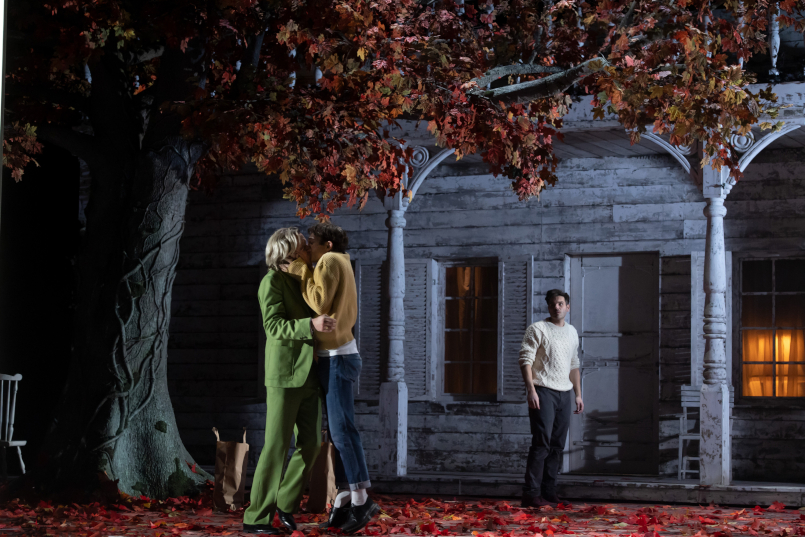
In this German version, there is more a “creative translation” of the prior English version, much like some of Simon Stone’s plays previously staged at the Residenztheater, which don’t feel like traditional German theater at all. But what does traditional German theater really feel like? This question kept coming to mind during the seven-hour epic. The naturalistic theater of the West End and Broadway sharply contrasts with German avant-garde theater. From ancient Greek myths to Shakespeare, then to modern Ibsen and Albee, Germans have rarely staged these plays “seriously.” Yet when such a finely crafted piece appears in Germany—powered by delicate dialogue, nuanced acting, accessible humor, and stirring excellence—the German audience sees it as cheap and lacking depth, overlooking how naturalistic theater, with its unique charm and sense of immersion, breaks the fourth wall in a different way. This play’s inclusion in the Top 10 of the 2023 Berlin Theater Festival is a good sign, and one hopes more naturalistic, Anglo-American works will flourish in German-speaking areas, teaching German directors and actors—who often just play concepts and deliver grand lectures—about the upper limits of traditional performance.
Rating: 9/10
German Difficulty: 6/10
Das Vermächtnis (The Inheritance)
Part 1 and Part 2
by Matthew Lopez
Directed and Stage Design: Philipp Stölzl, Costumes: Kathi Maurer, Composition: Ingo Ludwig Frenzel, Lighting: Gerrit Jurda, Stage Assistance: Franziska Harm, Dramaturgy: Ewald Palmetshofer.
Cast: Simon Zagermann, Nicola Mastroberadino, Thiemo Strutzenberger, Moritz von Treuenfels, Michael Goldberg, Oliver Stokowski, Vincent zur Linden, Florian Jahr, Vincent Glander, Noah Saavedra, Patrick Bimazubute, Nicole Heesters
Premiere: January 30, 2022
Duration: Part 1 approx. 3 hours, one intermission // Part 2 approx. 3 hours 30 minutes, one intermission
www.residenztheater.de