
Only love can save me, and love has destroyed me
Only love can save me, and love has destroyed me
Romance has become a luxury in our lives. While we scorn love with our words, deep inside we yearn to fall in love and embrace someone.
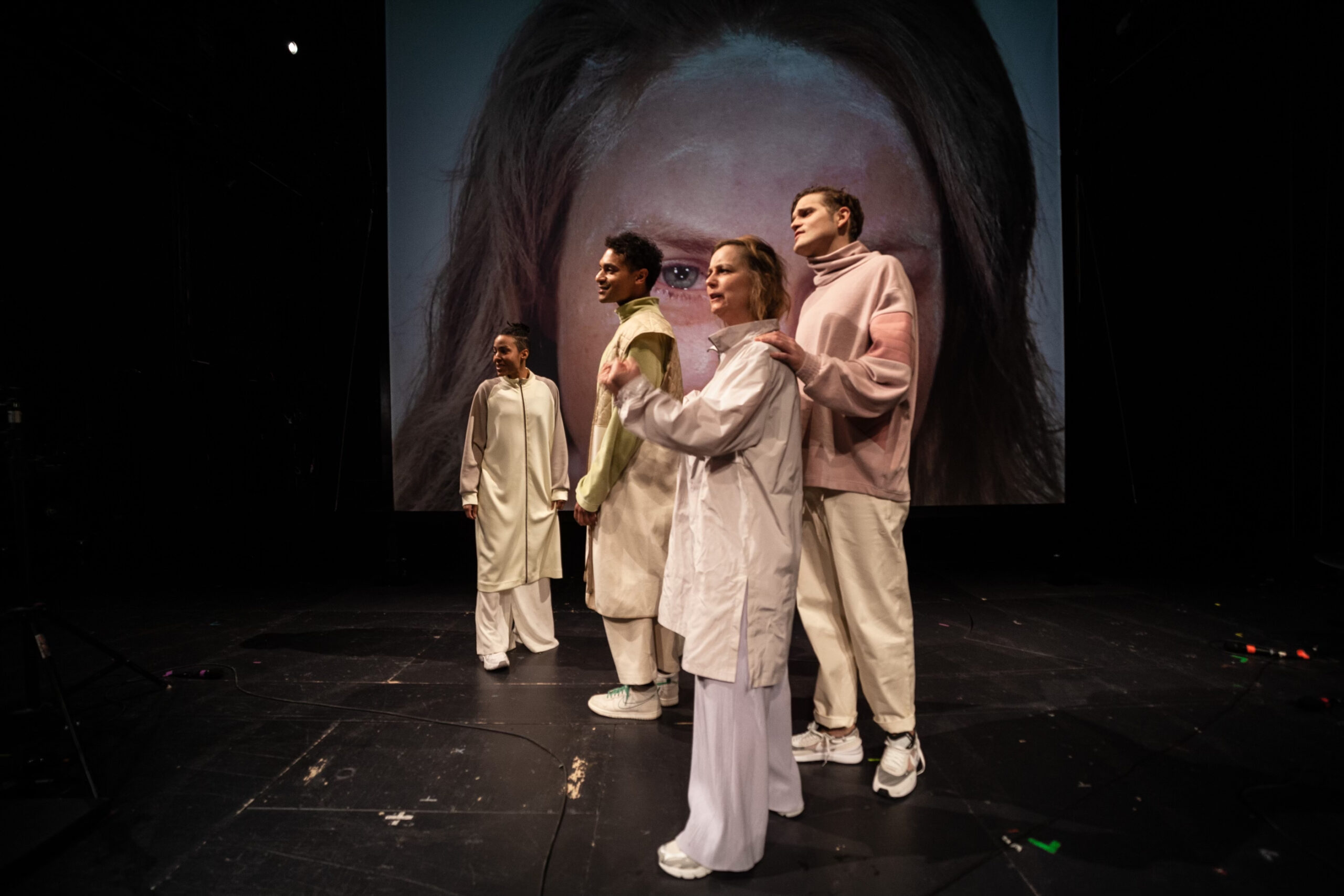
British writer Sarah Kane described her work as a “depiction of hell.” Each of her five plays is filled with extreme scenes and lines. In this 1998 play Desire, actors Maja Beckmann, Benjamin Lillie, Sasha Melroch, and Steven Sowah speak fragmented short phrases offstage with four voices, overlapping and interweaving like Zaha Hadid’s postmodern architecture, filling the entire space.
Wiebke Mollenhauer sits on stage, her face projected hundreds of times larger at the center of the stage. At this moment, our focus is no longer on the characters’ backgrounds or the motives of each line, but on how the words affect our inner feelings when we hear them. What comes to mind when we think of the word “love”? Most likely, it is a person’s face—perhaps our current lover or someone from a “past” in our lives. Facial expressions are the window through which we unconsciously interact with others. In this play, Wiebke’s magnified expressions, paired with the lines, evoke the waves stirred in our hearts by the protagonist’s story.
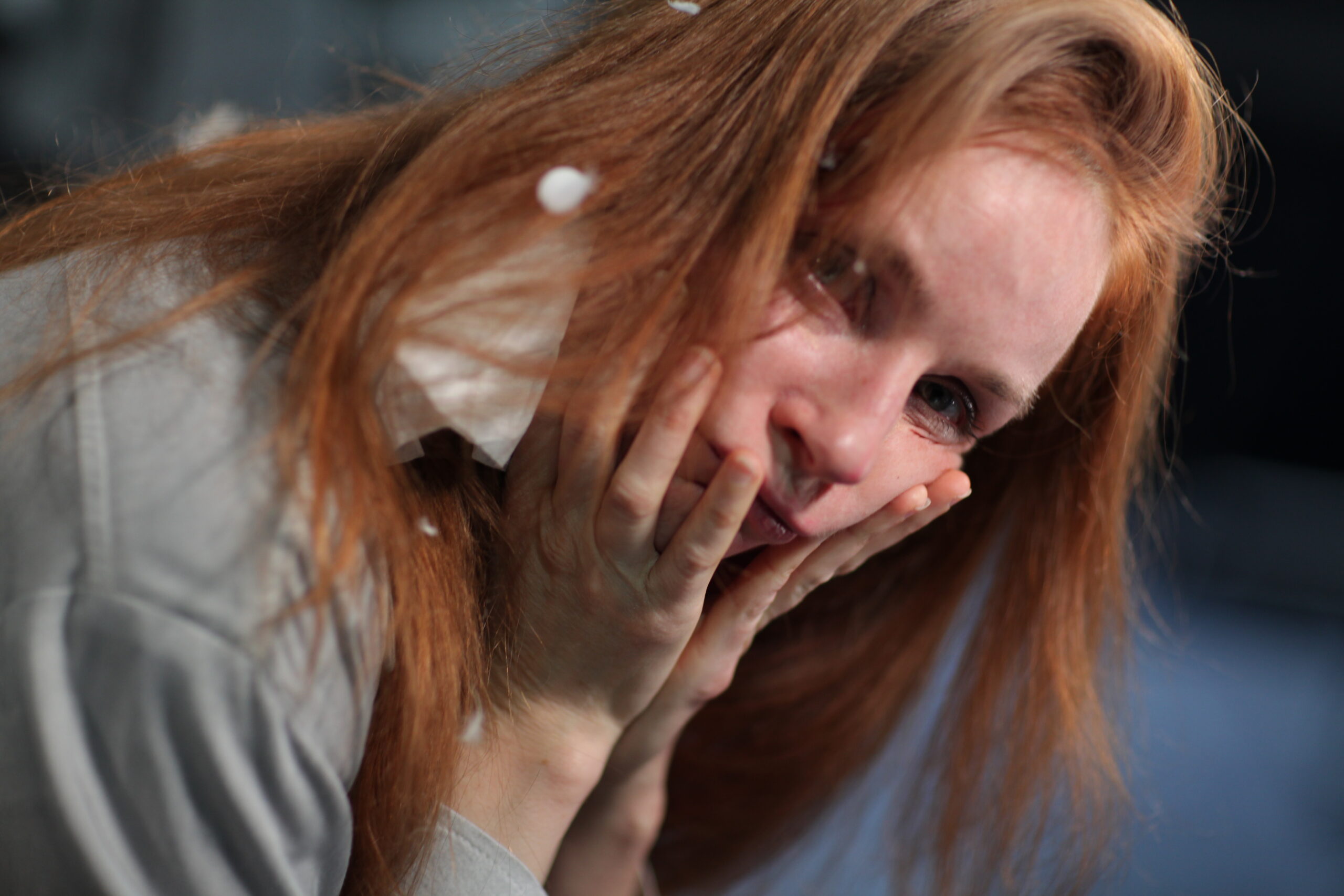
In Sarah Kane’s poetic text, fragments of conversation repeatedly appear, interspersed with commentary and associations related to the dialogue. These words are both harsh and tender. Childhood sexual trauma, the longing to be loved, relationships with parents, fantasies about intimacy, and fear of death. None of the lines spoken by the four voices is complete, but much like our memories, these flashing fragments gradually construct our recollections of the past. It is these memories that reveal the deepest imprint the traumas have left on us—a longing for security. But when the security we seek finally arrives, can we truly place all our hopes upon it? One heartbreak after another has gradually taught us that relying only on ourselves is the most reliable strategy. Yet, in the stillness of night, we still yearn for a love to which we can wholly surrender ourselves.
In the performance, the story unfolds from childhood physical abuse, through the confusion of adolescence, to eventual self-realization. Without uttering a single line, Wiebke uses only her expressions to masterfully toy with the emotions of the entire audience. What expression do you have when your grandfather, sitting next to you, exposes himself and the still-child you respond? What expression when, as a teenager, a stranger forces you to straddle him? What expression when you decide to completely abandon yourself, seducing every man who meets your gaze in a bar? Numbness? Crying? Or laughing out loud? Usually somewhat wooden on stage, Wiebke’s mesmerizing control of her facial expressions demonstrates acting at its peak. Compared with her, the usual leads Maja and Benjamin are completely overshadowed. She doesn’t say a word the entire evening, yet with her face and the text flowing alongside, she conveys surprise, sadness, anger, annoyance, excitement, pain, and fear. No one dares to look away from this brilliant acting at any moment. As the performance gradually draws to a quiet close, Wiebke, also the author Kane, and every one of us sitting in the audience, burst out of the theater, breaking free from the shackles that bind us and finally rush toward freedom and liberation. When the audience sees our souls finally find freedom, many are moved to tears; yet the author who depicted this freedom ended her own life a year after completing this work, escaping from the hell she described.

Kane’s text is complex, like a difficult long poem, but Rüping always manages to simplify the incomprehensible. In this play, the only thing the audience truly needs to “read” is Wiebke’s expression; the lines serve merely as reading aids. The stage design recalls Rimini Protokoll’s All Right, Good Night, also featuring a large screen in the center with thousands of lines continuously scrolling, contrasted with the actor’s complex facial expressions. Naturally, it is easier for the audience to “read” the latter. As the audience’s eyes remain fixed on the twenty-square-meter giant screen on stage, the brilliant director Rüping also selects a quartet, electronic music, pop songs, and various styles for the music, constantly switching styles within a segment of lines. The seemingly mismatched music strangely always manages to elevate the emotions to a peak. Accompanied by the music’s final movement, the scene is second only to the director’s earlier work Dionysus City’s final rising sun in terms of unforgettable impact.
Photo: ©Orpheas Emirzas
10/10 (Predicted Best of the Year)
German Difficulty: 2/5 (English subtitles)
Desire
by Sarah Kane
German translation by Marius von Mayenburg
Directed by: Christopher Rüping, Set Design: Jonathan Mertz, Costume Design: Lene Schwind, Music: Christoph Hart, String Trio: Jonathan Heck, Coen Strouken, Polina Niederhauser, Video: Emma Lou Herrmann, Live Video: Wilf Speller, Lighting: Gerhard Patzelt, Dramaturgy: Moritz Frischkorn.
Cast: Benjamin Lillie, Maja Beckmann, Sasha Melroch, Wiebke Mollenhauer, Steven Sowah.
Premiere on March 4, 2023
Duration: 1 hour 50 minutes, no intermission