标签: Felix Goeser

  • In der Sache J. Robert Oppenheimer

    In der Sache J. Robert Oppenheimer

    This article was first published in the April 2020 issue of <NCPA Magazine>
    Editor: Zhenzhen Cao

    “The whole damn thing was a farce, and now these people are trying to turn it into a tragedy.” That’s what atomic physicist Oppenheimer said afterward his interrogation in 1954.

    Oppenheimer is known as the father of the atomic bomb and was largely responsible for the Hiroshima atomic bomb program. In the 1940s and 1950s, the United States was losing in China and Korea, and there was a lot of domestic espionage, especially in 1953 when the Soviet Union became the first country to successfully detonate a hydrogen bomb, which brought McCarthyism to its peak. Oppenheimer, who had been lobbying Congress to control nuclear power and prevent the outbreak of nuclear war, became a natural target of suspicion throughout the country. Ten years after the bomb was dropped, he was tried by the Atomic Energy Commission in the United States, and his loyalty to the United States was questioned by everyone.
    © Arno Declair

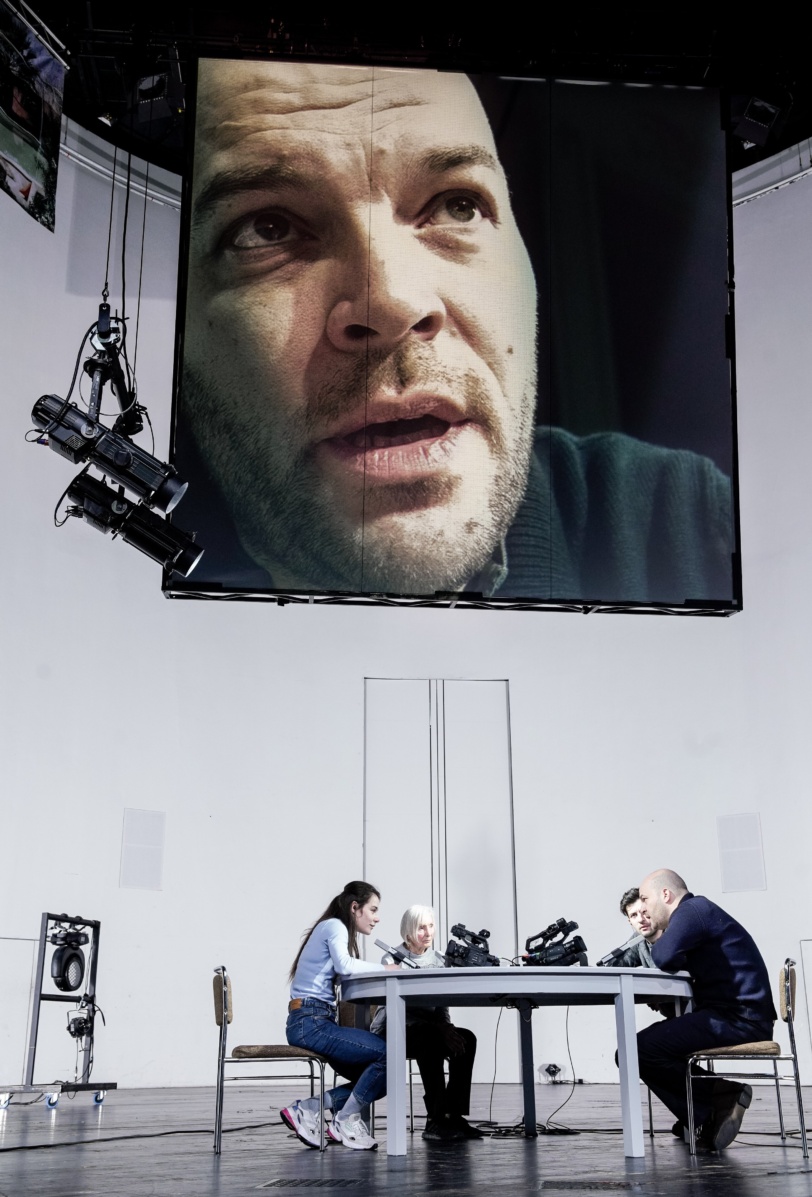
    The main stage of the Deutsche Theater in Berlin was enormous, with only four actors sitting around a small table against a bleak white backdrop illuminated by cold light. Every question asked by the judge, as well as by the prosecution’s lawyers, was relayed down from above through speakers, and the audience could hear both the speakers and the actors’ delayed retelling.

    This type of interrogation was partly in line with the American regulations of the time, and partly a gimmick of the director to use Brecht’s “distancing effect” to make people think that the actors on stage were not the characters they were playing, but simply actors. The faces of all the actors during the interrogation are projected by a camera placed in the center of a square table on a huge curtain hanging overhead, so that the audience can still see the subtle facial expressions of the actors from the back. On the other hand, the angles were different for each camera, and sometimes the actors, similar to the ones in House of Cards, suddenly spoke off-camera, indicating that “the truth is only a matter of perspective”.

    As the interrogation progresses, the people who are connected to Oppenheimer’s life are also being involved, from his wife who committed suicide because she couldn’t stand the pressure, to his successor, Edward Teller, the “father of the hydrogen bomb”, who believes that scientists should not think too much about this problem. Although the whole play is unpredictable, for example, each actor has to appear in a very grotesque dance to electronic music, but the plot is maintained in the original Docudrama format.
    © Arno Declair

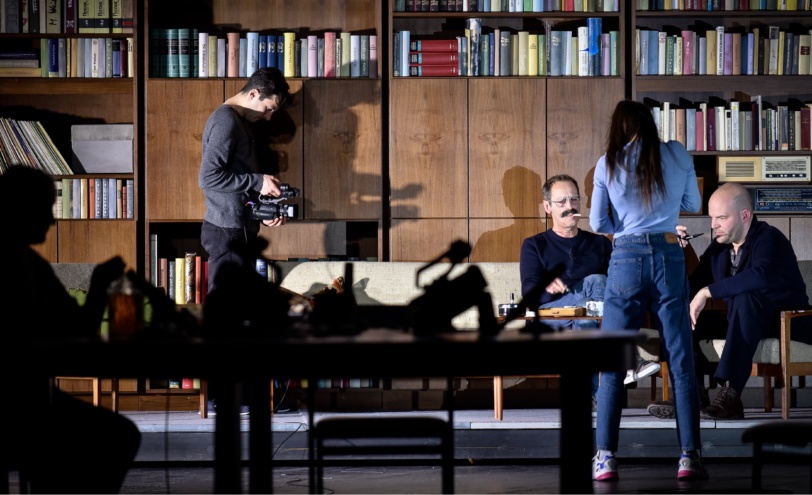
    In the second half, the set is changed from bleak white background to a living room full of books. The issues being discussed also become more complex. The content of the interrogations soon begins to slowly touch today’s society, and the content of this interrogation by playwright Heinar Kipphardt’s is in fact a prime example of the moral dilemma caused by technological advances.

    The digitisation of society, genetic research and the development of AI now create new possibilities and destructions of human races, yet the most frightening thing is that once it has begun, this process is irreversible. Especially with the precedent already set in recent years for genetically modified embryos and the rapid development of AI, let one wonders how much impact this will have on future generations.

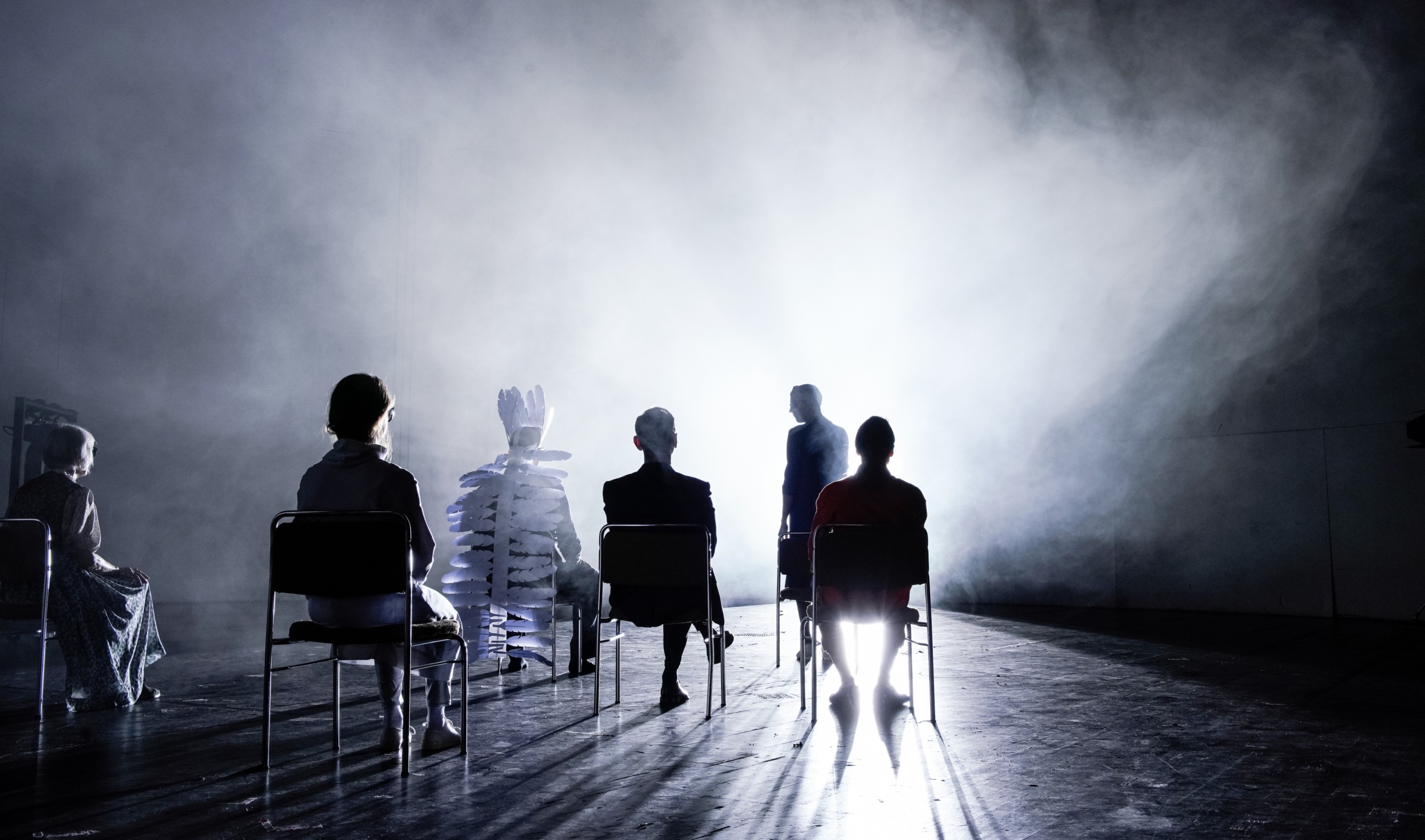
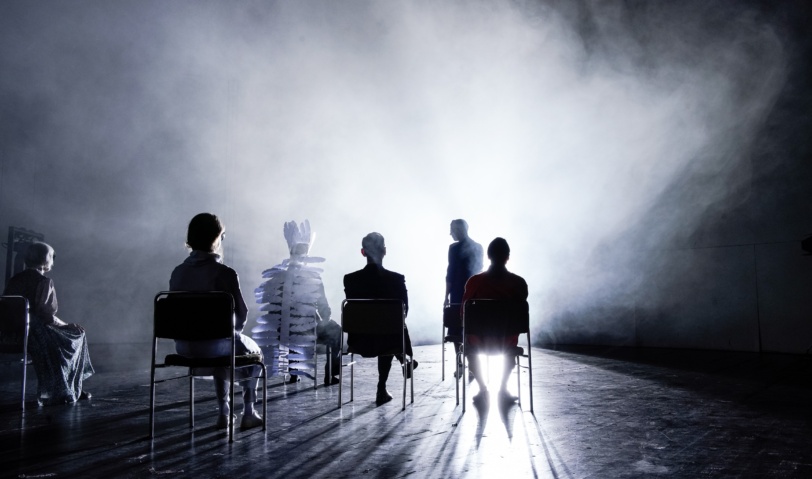
    In order to show the contemporary and futuristic nature of the story, the director adapted the original Oppenheimer’s confession of “spiritual treason” to a more modern and abstract approach at the end of the film. Everyone sat in their chairs with sunglasses on, and the electronic music in the background (produced with artificial intelligence by composer Christoph Hart) counted down louder and louder until a bright light came out from one corner of the stage.
    © Arno Declair

    At the end of this “explosion test”, everything returned to silence and darkness. Then, from a small door, lighted robots slowly emerged, one, two, three, until they were the only one left on stage, walking around erratically, creating a cyberpunk feeling, pulling the timeline from 1950 to 2050. In the new timeline, Oppenheimer’s back is draped with feathers in Indian attire, and mankind’s centuries-old civilization returns to a barbaric society after being destroyed by the atomic bomb. Felix Goeser, who plays Oppenheimer, looks back as he exits the stage, his eyes full of disappointment for humanity.

    Brecht said, “Everything new is better than everything old”. Director Lupin, who is very fond of new technology, this time offers an unanswerable critique of the fast-moving technology, that the rigorous scientist has become a thing of the past and that “everything in the future needs to be redesigned! When these words were shouted, the stage reverted to silence, and Oppenheimer’s head was hit by a holographic projection in the spewing smoke.

    ★★★★☆
  • 关于J. Robert Oppenheimer一案

    关于J. Robert Oppenheimer一案

    关于J·罗伯特·奥本海默一事

    本文首发于2020年4月刊《NCPA杂志》
    编辑:曹珍珍

    “整个该死的过程都是一场闹剧,而现在这些人试图把它变成一场悲剧。”这正是原子物理学家奥本海默在1954年被审问后的感叹。

    奥本海默被誉为原子弹之父,大部分负责了广岛原子弹计划。20世纪40至50年代,美国在中国和朝鲜失利,国内间谍活动频繁,尤以1953年苏联成为首个成功引爆氢弹的国家为标志,麦卡锡主义达到顶峰。奥本海默一直在游说国会控制核能,防止核战争爆发,因此成为全国怀疑的天然目标。原子弹投下十年后,他被美国原子能委员会审判,人人质疑他对美国的忠诚。

    © Arno Declair

    柏林德意志剧院的主舞台极为宏大,只有四名演员围坐在一张小桌旁,背景是一片冷峻的白色幕布,冷光照射下显得格外凄清。法官和检方律师的每一个提问都是从上方通过扬声器传送,观众既能听到扬声器的声音,也能听到演员们延迟复述的回答。

    这种审讯方式部分符合当时美国的规定,部分是导演利用布莱希特的“疏离效果”的手法,让观众明白舞台上的演员并非角色本身,而仅仅是演员。审讯过程中,所有演员的面部表情都通过置于正方形桌子中央的摄像机投影到悬挂于头顶的大幕上,从后台依然可以看到演员微妙的面部动态。另一方面,每个摄像机角度不一,演员有时会突然在镜头外发言,类似美剧《纸牌屋》,暗示“真相只是视角问题”。

    随着审讯的深入,涉及奥本海默生活的人也被牵扯进来,从因压力自杀的妻子,到他的继任者,被称为“氢弹之父”的爱德华·泰勒——他认为科学家不应过分深思这些问题。虽然整部剧充满不可预料的变化,比如每位演员都要伴随电子音乐进行极端怪诞的舞蹈,但情节依旧保持原有纪录戏剧体裁。

    © Arno Declair

    下半场布景从冷清的白色背景换成满是书籍的客厅,讨论的议题也更为复杂。审讯内容很快开始触及当今社会,而该剧作家海纳·基普哈特的这场审讯,事实上是技术进步所引发道德困境的典型代表。

    社会数字化、基因研究及人工智能的发展,既创造了新机遇也带来毁灭性的风险,且最可怕的是一旦开始,这一进程不可逆转。特别是近年来基因改造胚胎和人工智能的迅猛发展,让人不禁思考对未来世代会带来多大影响。

    为了呈现故事的当代及未来感,导演在影片结尾将奥本海默原始的“精神叛国”自白转化为更现代、更抽象的表现方式。所有人戴着墨镜坐着,背景的电子音乐(由作曲家克里斯托弗·哈特利用人工智能制作)声势渐强,数秒倒计时,直到一个角落射出耀眼光芒。

    © Arno Declair

    在这场“爆炸测试”结束后,一切恢复了寂静和黑暗。随后,一扇小门缓缓打开,带灯的机器人缓缓走出,一个、两个、三个,直到他们成为舞台上唯一的存在,行为不规则,营造出赛博朋克氛围,将时间线从1950年推至2050年。新的时间线上,奥本海默背披印第安风格的羽毛装,人类历经数百年文明积淀后,在原子弹摧毁后退回野蛮社会。扮演奥本海默的费利克斯·戈泽尔走出舞台,回头望去,眼中充满了对人类的失望。

    布莱希特曾说:“一切新事物都胜过旧事物。”热爱新技术的导演鲁平这次对飞速发展的科技提出了无可回答的批判——严谨的科学家已成过去,“未来的一切都需重新设计!”当这句话被喊出,舞台陷入寂静,奥本海默的头部被喷烟中的全息投影击中。

    ★★★★☆

  • 这事不会发生在这里

    这事不会发生在这里

    这不会发生在这里

    诺贝尔文学奖得主辛克莱·刘易斯(Sinclair Lewis)的原著写于1935年,正值希特勒崛起之初。故事描绘了一位名叫巴兹·温德里普(Buzz Windrip)的美国政治局外人和民粹主义者如何登上美国总统宝座。温德里普在1936年的选举中击败了罗斯福,并在短时间内,在被遗忘者联盟(Forgotten Men’s Alliance)的支持下,美国陷入了独裁统治。渗透司法体系后,他统治的首个牺牲品是新闻自由,这通过报纸编辑多雷姆斯·杰萨普(Doremus Jessup)这个角色表现出来,起初他只是被压制,后来甚至遭受了身体上的伤害。

    © Arno Declair

    在20世纪30年代中期,美国人对希特勒执政下德国政治形势的看法是:“这不会发生在这里。”时至今日,随着特朗普执政以及右翼在多个欧洲国家越来越趋于主流,许多德国人依然以当年美国人看待纳粹德国的眼光来看待美国。

    开场场景是一场辩论,左派的杰萨普与右翼的党魁李·哈里森(Michael Goldberg)、海克将军(Benjamin Lillie)对峙,双方试图向观众阐述各自的理论,记者显然处于劣势。随着党魁的逻辑一步步引导观众的认知,自然过渡到巴兹·温德里普(Felix Goeser)当选总统的时刻。

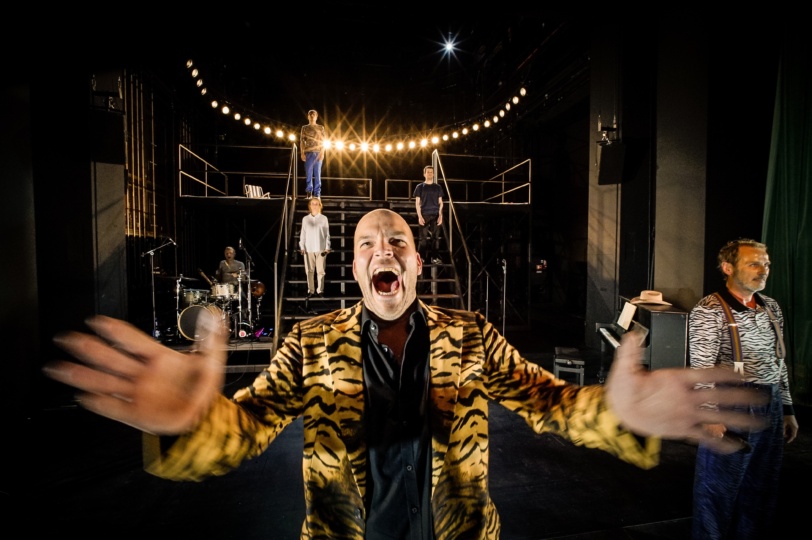
    背景升起,强烈的白光从背后照射观众,音乐响起,一切变得史诗般震撼,这一刻真的让人爱上了Rüping。

    © Arno Declair

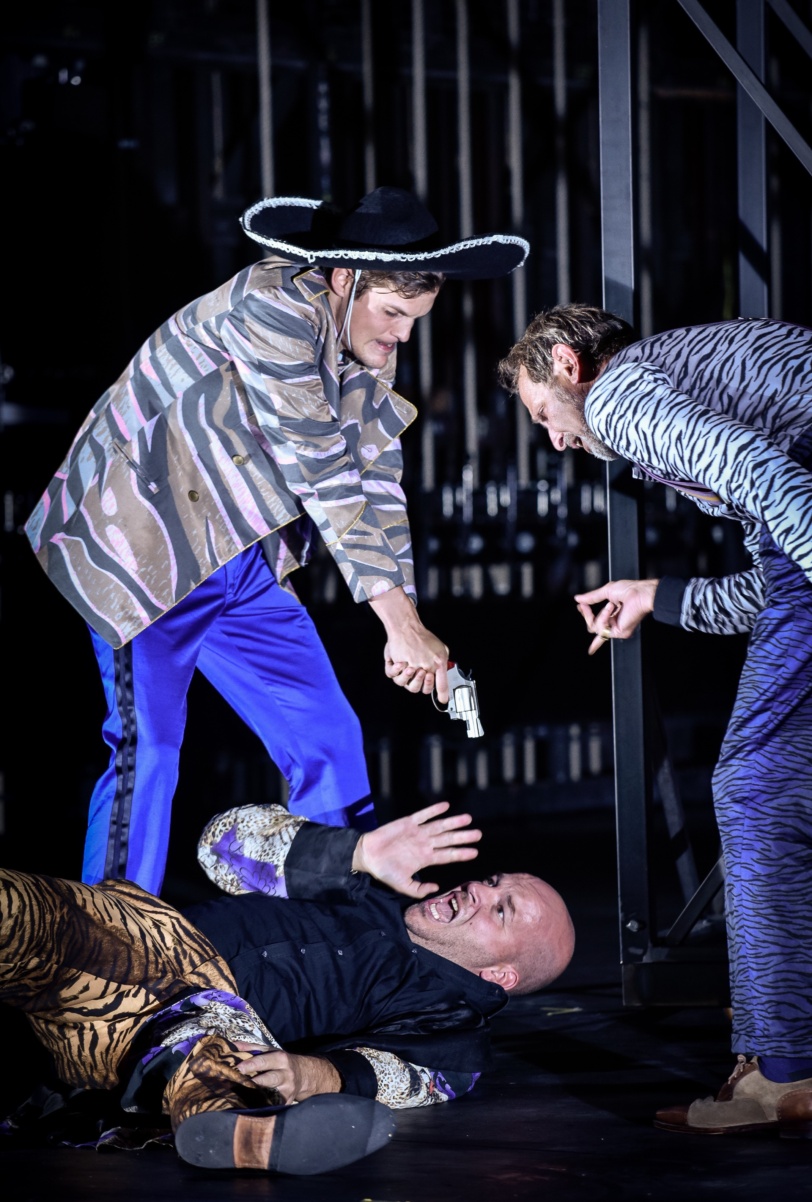
    Felix Goeser对这位新当选总统的诠释非常精彩。扮演智囊团成员的Michael Goldberg同样全力演出,从一开始的谦恭有礼到当选总统时的迷茫。最后,Benjamin Lillie饰演的将军既跳舞又用变声器歌唱,将情感推向高潮,尤其是演出末尾的独奏令观众体验了一场多巴胺的爆发!Rüping巧妙地在观众可能感到乏味的表演低谷时邀请他们吃热狗。

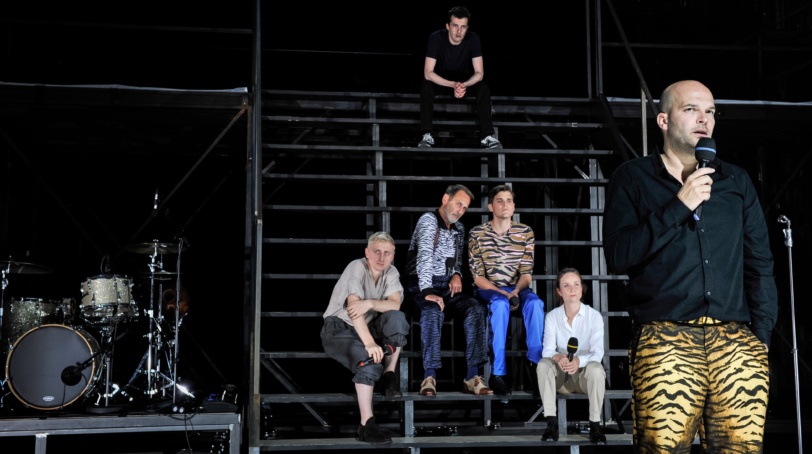
    舞台布置上下两侧观众坐席环绕,中间高架搭建总统站立,两侧挂降两面纳粹旗帜,颇似电影中希特勒面对成千上万SS士兵的场面。吃完热狗后,海克将军站在舞台前朗读自总统上任以来解雇的内阁成员名单,每念一名观众便从舞台后方走回座位,宛如特朗普刚任职时大规模辞退官员。非常精彩!

    © Arno Declair

    自特朗普执政以来,我见过的大多数左派都是为了反对而反对,缺乏有力论据,充斥着自我理想主义而忽视现实。舞台剧作品罕有深刻,多是拿特朗普当笑柄。唯独这部剧,我能理性理解导演对民粹主义复兴的不满,即使没有我附加给Rüping的光环,我仍觉得是今年我看到的泛政治题材中最好的处理。

    ★★★★★

    无疑是2019年最佳!


  • It Can’t Happen Here

    It Can’t Happen Here

    The original book by Sinclair Lewis, winner of the Nobel Prize for Literature, was written in 1935, at the beginning of Hitler’s rise to power.The story depicts the ascension of an American political outsider and populist named Buzz Windrip who took the presidency of the United States. Windrip won the 1936 election against Roosevelt, and within a short time, with the support of the Forgotten Men’s Alliance, the U.S. has fallen into a dictatorship. After infiltrating the judicial system, the first victim of his rule was freedom of the press, as portrayed by the character of newspaper editor Doremus Jessup, who was first only suppressed but then suffered physically

    © Arno Declair

    In the mid-1930s, the American view of the political situation in Germany under Hitler was: “It can’t happen here.” Today, with Trump in power and the right becoming more and more mainstream in several European countries, many Germans still view the United States in the same way that Americans viewed Nazi Germany at the time.

    The opening scene begins with an argument between Jessup on the left and party leader Lee Harrison (Michael Goldberg), General Haik (Benjamin Lillie) on the right, with both sides trying to explain their theories to the audience, the journalist is clearly at a disadvantage, and as the audience’s perceptions are led forward step by step by the party leader’s logic, it is a natural progression to the moment when Buzz Windrip (Felix Goeser) is elected as president.

    The background raises, the intense white light hits the audience from behind, the music starts, and everything becomes epic and jaw-dropping, a moment that really makes you love Rüping.

    © Arno Declair

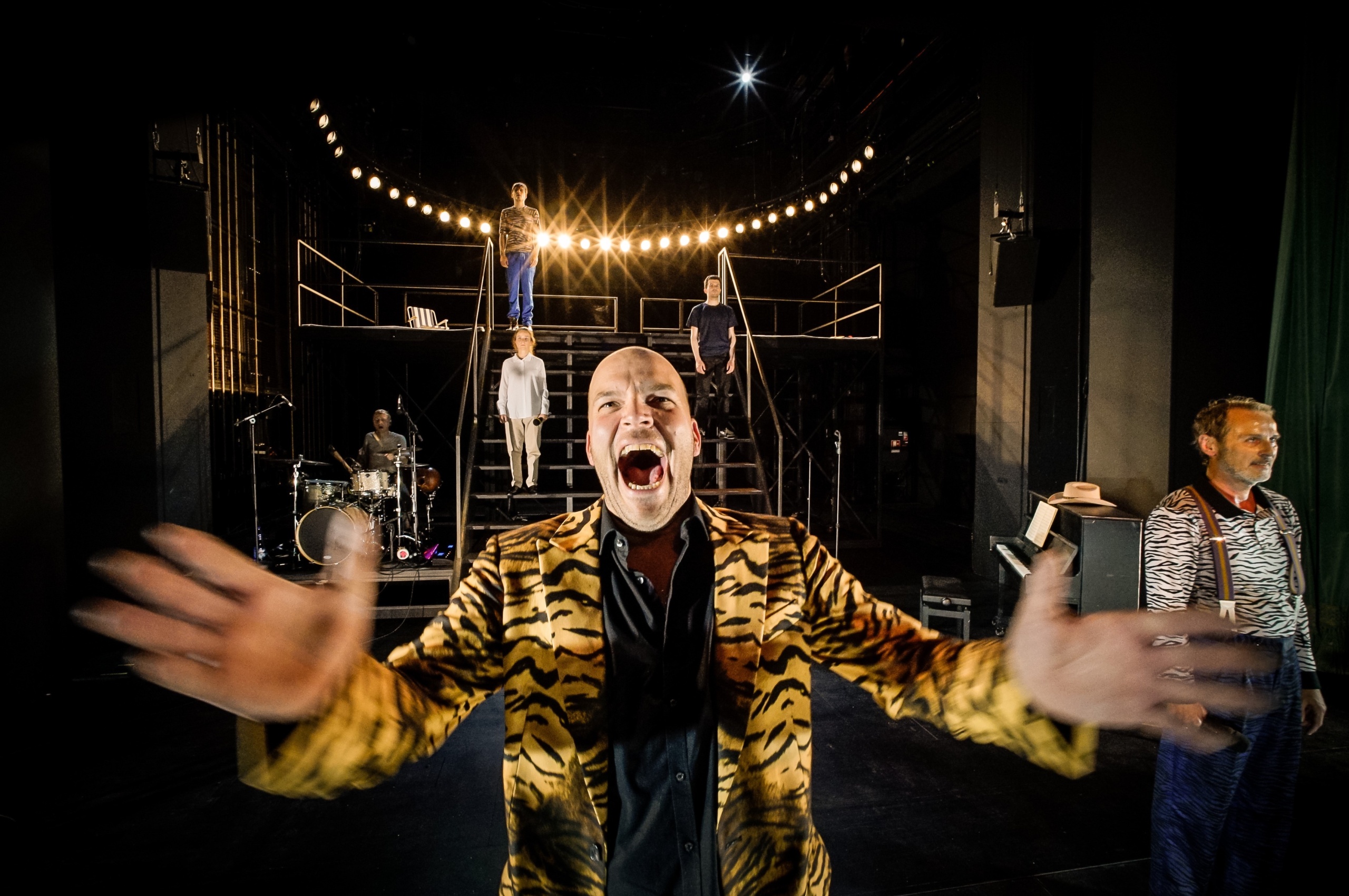
    Felix Goeser’s interpretation of the newly elected president’s is very nicely rendered. Michael Goldberg, who plays the think-tank, also plays the role to the hilt, from his yes-manners at the beginning to his confusion when he becomes president. Last but not least, Benjamin Lillie, who played the General, danced, sang with a voice changer, brings the emotion to a climax, especially the solo at the end of the show which gave audience a dopamine rush! Rüping cleverly invites the audience to eat hot dogs at the lowest point of the performance when the audience might be bored.

    The scene was set up with the audiences sitting on both sides of the stage, and the President standing on the tall scaffolding in the middle, while two Nazi flags were lowered from both sides of the scaffolding, much like in the movie when Hitler faced the thousands of SS soldiers. After eating hot dog, General Haik reads in front of the stage the names of the cabinet members that the new president has fired since he took office, and each time a name is read, a member of the audience walks from the back of the stage back into their seat. Just like the massive fire Trump did when he first took the office. Very nicely done!

    © Arno Declair

    Since Trump came to power, most of the leftists I’ve seen have been opposing for the sake of opposition without much of arguments, full of their own Idealism without any regard for reality, and the productions that have been brought to the theater stage have rarely been profound enough, but have simply used Trump as a laughing stock in their productions. Only with this play, I can logically embracing the director’s dissatisfaction with the populist revival, and even without the aura I attached to Rüping, I felt it was the best handling of the pan-political works I’ve seen this year.

    ★★★★★

    Undoubtedly the best of 2019!